
Have you ever been part of a team where everything just seemed to flow effortlessly? Chances are, the diversity of personalities and the complementarity of team members played a key role in that success. In this article, discover tips for leveraging different personality styles to improve your team's cohesion.
Do you know the Atmanco personality Styles?
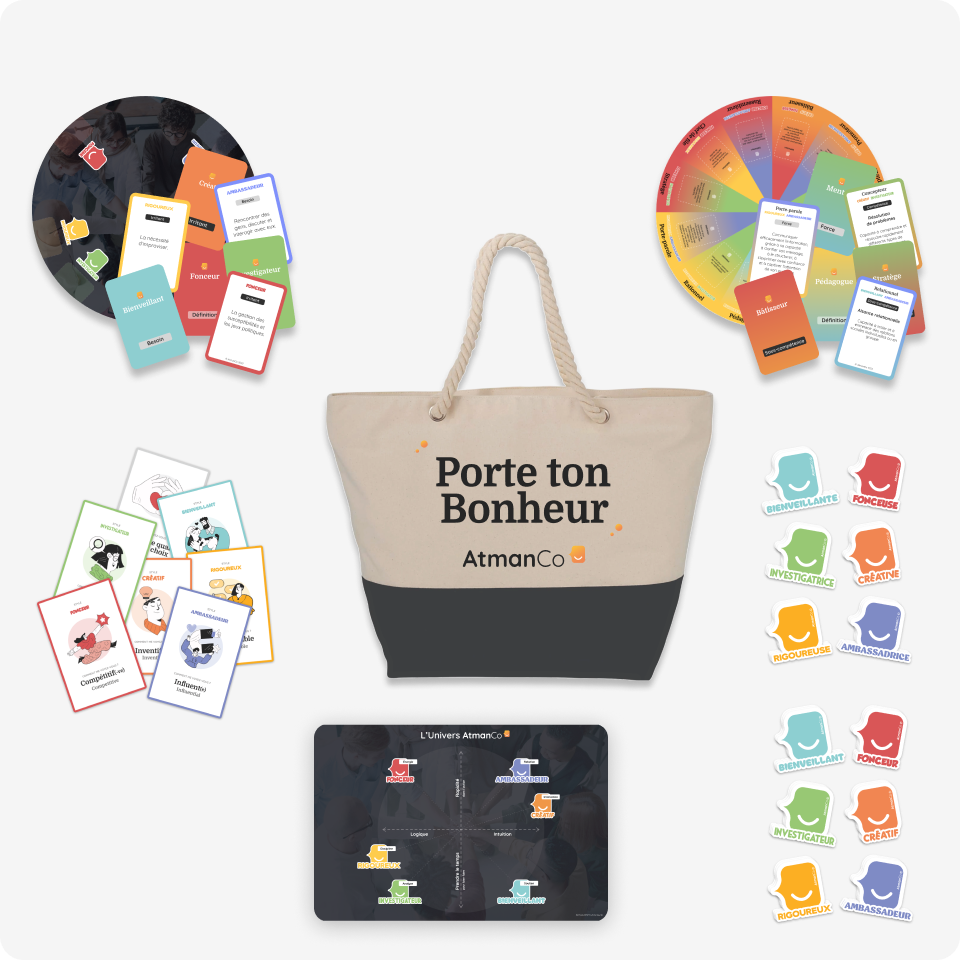
AtmanCo has identified six personality styles that can significantly influence team dynamics. These six distinct styles are a way to better understand your team members and foster stronger collaboration.
6 AtmanCo personality Styles:
Caring
Driver
Creative
Rigorous
Investigator
Ambassador
By understanding these six personality styles within your team, you can leverage each person's strengths, manage conflicts constructively, and boost productivity.
Understanding team complementarity
You've probably heard the expression "You're the Yin to my Yang." When two people with opposite personalities collaborate, they can combine their strengths to find balance. For instance, if you tend to focus on the big picture and project strategy, a partner who is naturally oriented toward rigor and process can ensure that crucial details don't get overlooked.
The same principle applies to cooperation. Different personalities can work more effectively together to achieve their goals. A Creative paired with a Rigorous, that's innovation that never loses sight of the details. A Caring alongside a Driver, that's the human element and results moving forward together.
These examples show how personality diversity can strengthen team cohesion and productivity. Many people think they know their colleagues' personalities well, but our assessments of ourselves and others can be clouded by false perceptions. It's best to use scientifically validated psychometric tools to truly understand each team member.
The relationship between communication and personality Styles
Behind every high-performing team is communication that works. This is no coincidence: better mutual understanding means less wasted energy and more results. Here are some strategies to get there:
1. Build shared understanding through self-assessments
Fostering mutual understanding within the team can start with organizing a meeting where each member shares their perception of their own personality style and how they believe it influences their approach to work. Encourage open discussion and invite everyone to share their personal self-assessments as well as their observations of colleagues. This conversation will surface insights about individual communication preferences, learning styles, collaboration preferences, and comfort zones, even without formal personality assessments.
If you've done your AtmanCo personality style assessment: You can also do this exercise by sharing your dominant and secondary personality style. The 6 AtmanCo Personality Styles help simplify discussions, deepen your understanding of each facet of your personality, and identify your natural talents.
2. Collaborating across personalities: Speaking the same language
Identifying your team's personality styles is a good start. Using them day-to-day is even better. The key: adapt your communication to each person's preferences rather than imposing a one-size-fits-all approach.
Is your team mostly made up of Creatives? Lean into brainstorming, new tools, and unconventional formats - they're more engaged when they can explore. Do you mostly have Drivers? Be concise, keep conversations focused on goals and concrete outcomes. One message, delivered in multiple ways - that's the kind of communication that builds cohesion.
3. Know yourself to work better together
To foster self-awareness within the team, be receptive to feedback from your teammates. Each personality brings unique perspectives that can significantly contribute to improving team synergy and performance. Every style brings something distinct to the table. By understanding and valuing these different approaches, you create a more cohesive group - one that can fully leverage diversity while strengthening the sense of belonging.
4. Pursuing common goals
Recognizing and understanding the different personalities on your team is a valuable asset in achieving shared objectives. Using personality styles allows you to grasp the individual motivations and career goals of each team member. By appreciating the specific strengths of each personality style and how they complement the group, you can build high-performing teams.
For example: a Creative can bring innovative ideas, a Caring can facilitate conflict resolution, a Rigorous can ensure accuracy in the details, an Ambassador can create unifying events, a Driver can steer toward results, and an Investigator can solve complex problems.
By understanding these unique contributions, you can align individual goals with those of the team - creating a dynamic that strengthens collective performance. Every member will feel valued, understood, and motivated to actively contribute to achieving shared goals.
Keep the conversation going
Strengthen team collaboration through the activities in the Happiness Toolbox, your toolbox for delivering unique team-building experiences that spark discussion, strengthen bonds, and boost performance.