

Most Companies Buy the Wrong Assessment for the Right Reason
Here's the harder truth: the interview didn't fail because you asked the wrong questions. It failed because an interview, on its own, was never built to answer the question you actually needed answered: will this person do the job well, work well with this team, and stay? That's the gap a validated psychometric assessment exists to close: the space between what a résumé and an interview can tell you, and what actually predicts whether someone will succeed in a role.
Assessments need to hold up across a multilingual, geographically dispersed workforce, not just a single-language talent pool. And the story doesn't end at the offer letter. What happens in the first ninety days determines whether that good hiring decision turns into a good outcome, which is why employee onboarding deserves the same evidence-based rigour as the hiring decision itself.
This guide breaks down what a psychometric assessment actually needs to get right, from initial evaluation through employee onboarding to talent development, and where AtmanCo's IMDP™ Scientific Model fits into that picture.
Most companies buy the wrong assessment for the right reason: What makes the best psychometric assessment platform?
What Is a Psychometric Assessment?
A psychometric assessment is a scientifically validated instrument that measures job-relevant psychological attributes (cognitive ability, personality traits, and motivational drivers) to predict how a candidate or employee is likely to perform in a specific role. Unlike an unstructured interview, which relies on subjective impressions formed in fifty minutes, a validated assessment produces standardized, evidence-based insights that can be compared consistently across candidates.
The distinction matters for two reasons. First, psychometric assessment describes a validated measurement instrument, not the same thing as a personality test, a term that in common usage tends to describe informal, consumer-facing quizzes with no predictive validity behind them. You've likely taken one of those for fun. This is not that. Second, not every instrument marketed as psychometric is built on the same thoroughness. Some vendors sell a proprietary-sounding framework with no published validation behind it at all. That's where evaluation criteria come in, and where a hiring manager who knows what to ask can tell the difference in about two minutes.
Five Criteria That Separate a Strong Assessment From a Weak One
1. Scientific Validation, Not Just a Framework
A credible psychometric assessment should point to peer-reviewed validation research, reliability and predictive validity data, not just a proprietary framework with marketing language wrapped around it. Ask any vendor two direct questions: how long has this model been validated, and against what outcomes? If the answer is vague, that's your answer.
AtmanCo's IMDP Scientific Model is built on over a decade of validation research, measuring candidates and team members across cognitive ability, personality, and motivation; the same three dimensions research consistently links to job performance. That's not a marketing claim. It's the reason the model has held up across industries and company sizes rather than needing to be reinvented for each new client.
2. Native Bilingual Validity, Not Translation
This is the criterion most Canadian buyers underweight, and it's the one that costs the most if you get it wrong. Many assessment platforms serving the Canadian market offer a French version of their tool, but that version is a translation of an English instrument, not a separately validated one. Translation preserves wording. It does not preserve psychometric properties. A translated item can shift in difficulty, tone, or interpretation in ways that quietly distort results for French-speaking candidates.
A natively bilingual psychometric assessment is validated independently in both French and English, so scores mean the same thing regardless of which language a candidate takes it in. This is a validity question, not a compliance checkbox. The risk isn't legal; it's that a mistranslated instrument can produce scores for French-speaking candidates that don't actually reflect the same construct being measured in English. IMDP was built bilingual from the ground up, not adapted after the fact; a structural difference from tools that added French as a secondary layer once the English version already existed.
3. Coverage Beyond the Hiring Moment
An assessment that stops at the hiring decision leaves value on the table, and this is where employee onboarding becomes the second half of the story, not an afterthought to it. The strongest psychometric assessments extend the same validated insights into onboarding, team fit, leadership potential, and succession planning, so the investment made at the point of hire keeps paying off through the entire employee lifecycle.
Think about what typically happens after an offer is accepted: the psychometric data that informed the hiring decision gets filed away, and the new hire's manager starts from scratch, learning through observation, over months, how this person communicates, what motivates them, and how they prefer to receive feedback. That's slow, and it's exactly the information the assessment already surfaced.
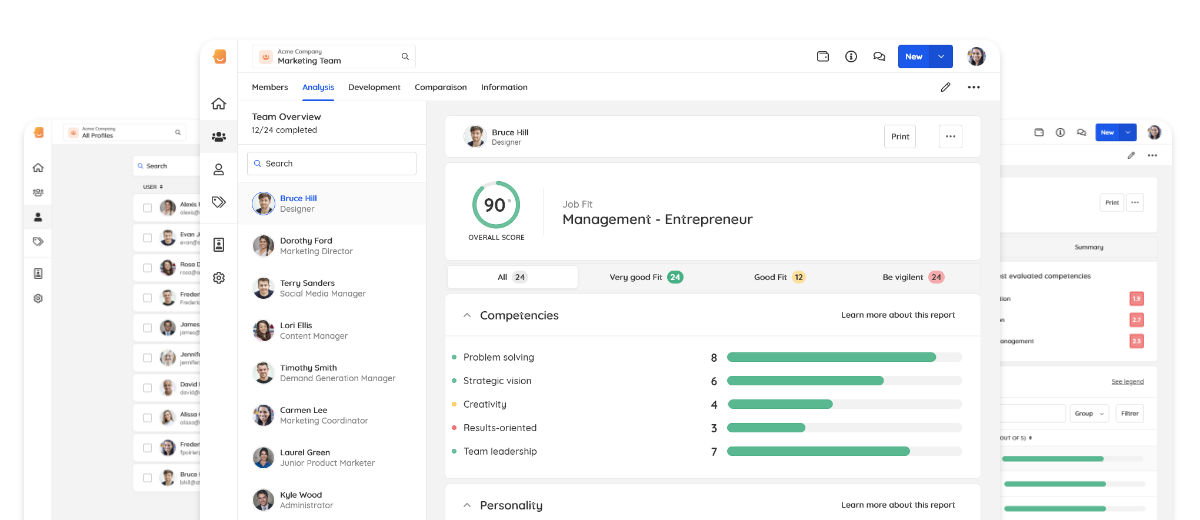
IMDP underpins AtmanCo's full module set, including JobFit for hiring, Styles for communication and team dynamics, Potential for leadership and succession, Complementarity for team composition, and Onboarding, all drawing from the same validated data set rather than requiring a new tool, and a new round of forms, for each stage of the relationship.
4. Actionable Reporting, Not Just a Score
A number on a page doesn't help a hiring manager make a better decision, and it doesn't help a manager onboard a new team member any faster either. A strong psychometric assessment translates its findings into structured interview guides, team-fit breakdowns, and development recommendations that a non-specialist can act on immediately, no interpretation course required.
This matters just as much on day one of employment as it does during the interview. A manager who receives a report that simply says "high conscientiousness, moderate extraversion" has learned very little about how to actually work with this person. A manager who receives a report that translates those traits into "this team member does their best work with clear, written priorities and structured check-ins rather than open-ended brainstorming" can use that insight in their first one-on-one meeting.
5. Fit for the Canadian Workforce Context
Beyond language, Canadian employers deal with realities that generic global assessments weren't built around: distributed teams across provinces, bilingual management structures, and a labour market where turnover is expensive and fast. Canadian voluntary turnover runs at roughly 10.2% annually, with an average replacement cost north of $30,000 per departure, and roughly 76% of those exits happen within the employee's first year.
That statistic alone should reframe how organizations think about onboarding: if three-quarters of voluntary departures happen in year one, onboarding isn't a welcome ritual. It's a retention intervention, and it starts with understanding who you just hired. A psychometric assessment that can't help catch fit problems before the hire, and can't help a manager build a better onboarding plan after it, is only solving half the problem.
What a Complete Psychometric Blueprint Actually Covers
Architects don't build from a single elevation drawing. A blueprint shows the structure from every angle (foundation, framing, wiring) because a building has to hold up under more than one kind of stress. The same logic applies to people decisions. A single score, or a single use case, gives you one elevation. What a strong psychometric assessment should give you instead is a psychometric blueprint: a complete, structural map of how a person is likely to perform, grow, work with others, and lead; read from one consistent set of data rather than reassembled from five disconnected tools.
That's a description of what a good assessment produces, not a brand name. The reason it matters is practical: if your hiring platform, your development platform, and your team-building platform each run on a different model, you can't actually compare what they tell you. A complete blueprint means every downstream decision including recruiting, competency design, development, team formation, culture fit, and leadership, draws from the same validated foundation. Here's what that needs to include:
Recruiting and Hiring: Screening at the Front End, Not Just the Final Decision
Hiring is the decision at the end of the funnel. Recruiting is everything that happens before it: sourcing, screening, and shortlisting candidates fast enough that a strong pipeline doesn't go stale while an interview loop drags on. A psychometric assessment earns its place here only if it can be deployed early and at volume, ranking a slate of candidates against a role's actual requirements before a recruiter invests hours in interviews that won't go anywhere. IMDP's JobFit module is built for exactly this; a consistent, scalable screen upstream of the interview, not a validation step bolted onto the end of it.
Competency Architecture: Defining What the Role Actually Requires
You cannot assess a candidate against a role you haven't defined. Competency architecture is the work of translating a job into a specific, measurable profile; the cognitive abilities, behavioural traits, and motivational drivers that separate strong performers from weak ones in that particular role, at that particular organization. Without this step, an assessment can only compare candidates to a generic population norm, which tells you how someone measures up to the average person, not how they measure up to what this job actually demands. A strong platform builds the competency model first, then assesses against it, so fit means fit for this role, not fit for a category.
Talent Development: Charting Growth After the Hire
The same profile that informed a hiring decision should keep informing that person's growth long after they've started. Development, not training, which implies a fixed curriculum delivered the same way to everyone, means using an individual's psychometric profile to identify where they'll grow fastest, what kind of stretch assignments will build on their strengths, and where a manager should expect to coach rather than correct. A platform that stops generating value after the hiring decision has already given up on most of an employee's tenure.
Team Mobilization: Assembling the Right People Around the Right Work
Hiring and developing individuals well doesn't automatically produce a well-functioning team. Team mobilization is the deliberate work of assembling people, new hires and existing team members alike, around a specific project, account, or initiative, based on how their working styles, strengths, and motivations complement each other. This is where a psychometric assessment moves from an individual measurement tool to an organizational one: mapping how team members' profiles interact, so a manager can build a team with intention rather than by whoever happens to be available.
Organization Fit: Role, Team, and Culture, all Measured Together
Fit is not one number. A candidate can be an excellent match for a role's technical demands and a poor match for how their team communicates, or a strong match for their immediate team and a poor match for the organization's broader working norms. A complete psychometric assessment measures role fit, team fit, and fit with organizational health, how someone operates within the values, pace, and management style of the business, as three related but distinct questions, not one blended score. Treating them separately is what lets a manager diagnose why a placement isn't working, instead of just knowing that it isn't.
Leadership: Spotting and Building It Before You Need It
Leadership potential rarely announces itself in a résumé, and by the time a leadership gap becomes visible in performance reviews, it's already cost the organization months of underprepared succession. A strong psychometric assessment identifies leadership indicators, decision-making style, resilience under pressure, how someone influences others, early enough to build a development plan around them, not just to validate a promotion decision after the fact. Surfacing leadership capacity as part of the same profile used at hiring, so succession planning starts with evidence instead of a tap on the shoulder.
Put together, these six areas (recruiting, competency architecture, talent development, team mobilization, organization fit, and leadership) are what separate a genuine psychometric blueprint from a point-in-time hiring test. A platform that only does the first is a screening tool. A platform that does all six, from one validated foundation, is the thing organizations actually need.
Where Employee Onboarding Fits: Turning Assessment Data Into a Faster, Better Start
Most organizations treat onboarding as a checklist, equipment, paperwork, a tour of the office, a stack of policies to read. None of that is wrong, but none of it answers the question that actually determines whether a new team member becomes productive quickly: how does this specific person prefer to learn, communicate, and receive feedback?
This is where psychometric insight, applied at onboarding rather than filed away after hiring, changes the timeline. A new hire's profile can tell a manager, before day one, whether this person will ramp up faster with structured, written onboarding materials or with hands-on shadowing. It can flag whether their communication style leans direct or diplomatic, so the manager calibrates feedback accordingly from the first week rather than the third month. It can highlight motivational drivers (autonomy, recognition, and mastery) that a manager can build into early goal-setting conversations instead of guessing.
None of this requires a second assessment. It requires using the one you already ran.
Organizations that connect hiring data directly to onboarding design report smoother ramp-up periods and fewer of the early missteps, a mismatched communication style, an onboarding plan built for the wrong learning preference, that quietly erode a new hire's confidence in their first few months. This is precisely why 76% of Canadian voluntary exits happening in year one is not a coincidence: a rocky start compounds. Assessment-informed onboarding is one of the more direct ways to interrupt that pattern.
How to Weigh These Criteria During Evaluation
Picture an HR director at a 200-person professional services firm in Ontario, hiring for a client-facing role that's churned through three people in eighteen months. A generic screening tool might flag basic competency. A validated psychometric assessment built on IMDP would surface whether a candidate's motivational drivers and communication style actually align with the demands of sustained client relationship work, the kind of mismatch an interview alone tends to miss until it's already cost the team a year. And when that candidate is hired, the same profile feeds directly into their onboarding plan, so their manager isn't starting the relationship blind.
The evaluation question isn't: does this vendor use the word psychometric. It's whether the underlying model has validation data behind it, whether that validation holds up in both official languages, and whether the resulting insight does more than sit in a PDF after the hiring decision is made.
Frequently Asked Questions
Is a psychometric assessment the same as a personality test?
"Personality test" typically refers to informal, consumer-oriented quizzes without predictive validity research behind them. A psychometric assessment is a scientifically validated measurement instrument used for employment and development decisions.
Why does bilingual validation matter for a Canadian psychometric assessment?
An assessment translated from English into French may not preserve the same psychometric properties across both language versions, meaning scores could reflect different things depending on which language the candidate uses. A natively bilingual assessment is validated independently in each language, so results are comparable regardless of language.
What is a psychometric blueprint?
It's not a product name; it's a description of what a complete psychometric assessment should produce: a single, structural map of a person that covers role fit, team fit, and organizational fit, along with development and leadership potential, all drawn from one validated foundation rather than pieced together from separate tools.
How does psychometric assessment improve employee onboarding?
The same validated profile used to make a hiring decision can inform how a manager structures a new hire's first weeks, communication style, learning preference, and motivational drivers all shape what an effective onboarding plan looks like. Using assessment insight at onboarding, rather than filing it away after the hire, gives managers a head start instead of a few months of guesswork.
How much does a bad hire cost a Canadian company?
Canadian voluntary turnover runs at approximately 10.2% annually, with an average replacement cost of $30,000 or more per departure, and roughly 76% of voluntary exits occurring within the employee's first year, underscoring why the onboarding period deserves as much attention as the hiring decision itself.